

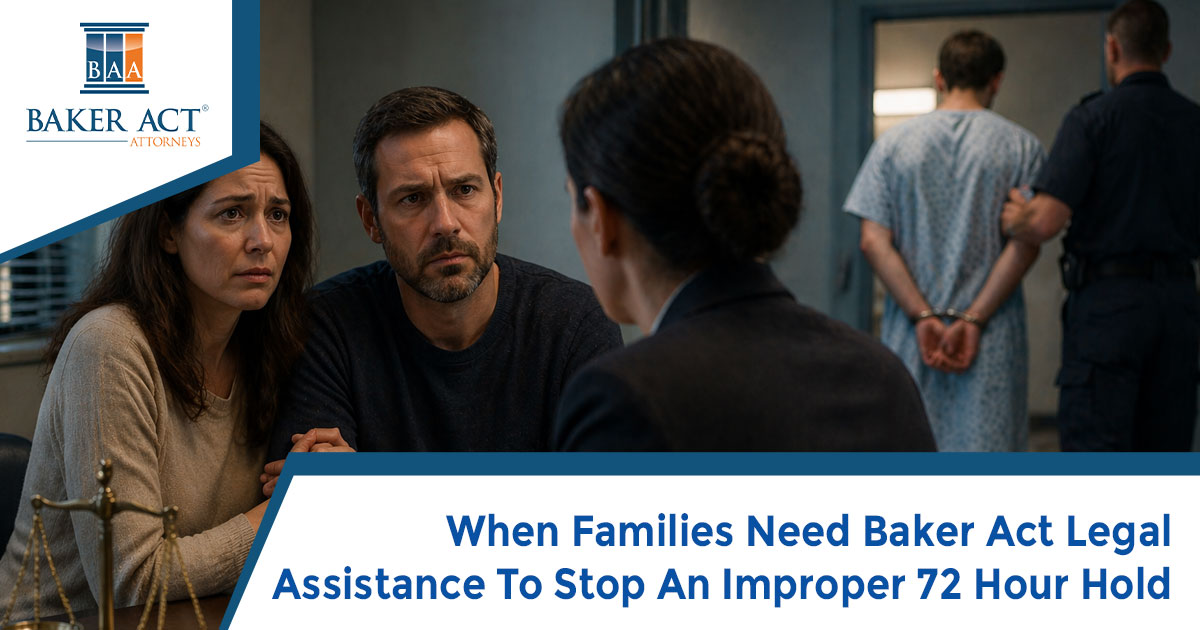
The Baker Act has noble intentions, namely to allow for involuntary mental health evaluation and the temporary detention of an individual experiencing a serious mental health crisis. However, sometimes the Baker Act is not enacted properly, and the intervention is not appropriate.
While the goal is to offer crisis intervention and safety for the individual and those around them, there are times when the 72-hour hold that follows is not appropriate or relevant.
Here is what families need to know when helping a loved one stop an improper hold, and how Baker Act legal assistance can help.
The Purpose of the Baker Act
The Baker Act is a legal framework in Florida that allows for the involuntary, temporary detention of someone who may be experiencing a serious mental health crisis and poses a risk to themselves or others. Formerly known as the Florida Mental Health Act, the Baker Act allows certain professionals, such as doctors, judges, law enforcement officers, and mental health specialists, to take someone to a designated facility for evaluation without their consent.
For the Baker Act to be properly implemented, there must be sufficient reason to believe the person has a mental illness, is a danger to themselves or others, or is unable to care for themselves and may suffer harm if not evaluated and appropriate next steps taken.
The process involves the person being held for up to 72 hours for evaluation, during which the next steps are determined. After evaluation, the individual may be released, asked to enter voluntary treatment, or referred for longer-term involuntary treatment through a court process.
The main goal of the Baker Act is to provide crisis intervention and ensure safety for the individual and those around them, but there are times when the 72-hour hold is not appropriate. When the Baker Act is misused or overreached, it can lead to unnecessary detention and emotional distress, disrupting both the individual and their family.
In such instances, legal assistance may be required to challenge an improper hold.
Understanding Rights Under the Baker Act
It is important to understand an individual’s rights under the Baker Act in order to challenge an improper hold.
- An individual has the right to due process and to be notified of why they are being held.
- An individual has the right to be evaluated within the required 72 hours, after which further options are presented.
- An individual has the right to legal representation through an attorney.
- An individual has the right to challenge the Baker Act in court for longer-term involuntary treatment.
- An individual has the right to humane treatment, to be treated with dignity and respect, and to have contact with family members, legal counsel, and others.
- When possible, an individual also has the right to informed consent, particularly regarding medication and treatment, unless legally justified in an emergency or by court order.
In Florida, the Baker Act can be initiated on minors even without parental notification. In these instances, parents have their own set of rights, including requesting an immediate explanation (with access to the clinical record), gaining access to their child, contacting a lawyer, and attending any hearings that may follow.
Acquiring legal assistance from a Baker Act attorney can help you explore the various grounds on which the Baker Act may be challenged, from demonstrating that the person detained does not meet the legal criteria for the hold to showing that other forms of treatment may be more appropriate, such as an outpatient facility or treatment under the Marchman Act. A legal professional can help you assess these options and choose the most appropriate course of action.
Steps to Challenge an Improper Baker Act
The best chance of challenging a Baker Act detention is to follow the right processes. As a guideline, consider the following.
Contact a Baker Act Attorney
Contacting Baker Act legal assistance should be done as quickly as possible, as the facility must evaluate the individual within 72 hours.
A Baker Act attorney experienced in these cases will have the legal expertise to review the legality of the detention and advocate for the individual and their family. When appropriate, they can demand immediate release if the legal criteria for detention have not been met. If the case reaches court, they can also provide representation at hearings, ensuring that rights are protected and that fair and just representation is provided.
While it is important to act promptly when challenging a Baker Act, it is equally important to choose an attorney with specific experience in these cases, a strong understanding of mental health law, and a track record of handling involuntary hold challenges. An experienced attorney will be familiar with the process and able to act quickly, responsively, and with compassion in urgent situations.
Request a Hearing
If the end of the 72-hour hold results in a petition for further involuntary placement, this must be filed through the courts, and a hearing will be scheduled. In Florida, the hearing is generally required to take place within five business days.
Having an attorney represent your case is critical. If the hold was improper, an attorney can argue that the individual does not meet the legal criteria. For example, they do not have a qualifying mental illness or pose a danger to themselves or others. An attorney can also help demonstrate that the individual is capable of making their own decisions.
Prepare by Gathering Evidence
The court makes decisions based on evidence, and the stronger your evidence, the better your chances of a successful outcome. Key documentation may include witness statements, medical reports, video or audio recordings, and statements from mental health experts that challenge the Baker Act petition.
Rather than gathering and presenting this information on your own, it is best to work with an attorney experienced in handling these cases to build a strong argument and effectively advocate for yourself and your loved ones.
Evaluate Legal Options and Ongoing Support
Each case will have its own nuanced details, so it is important to consider the next steps based on the outcome. For example, you may want to assess the credibility of the person who initiated the Baker Act and determine whether there were any personal conflicts or malicious intent, and whether the Act was misused.
In some cases, next steps may include pursuing legal action against the facility or individual responsible on grounds such as false imprisonment, medical malpractice, or emotional distress.
It is also important to consider whether your loved one may still need support after release. For example, if there are genuine mental health concerns, families may need to step in and provide ongoing care. In another instance, if substance abuse was the cause of concern, you may want to consider the Marchman Act, which may be a more appropriate avenue to pursue.
A Baker Act attorney can offer comprehensive guidance on the most appropriate path forward, whether that involves a reputable treatment facility, a trusted psychiatrist, or another mental health professional.
Compassionate Baker Act Legal Assistance
If you are concerned about a loved one who has been placed under the Baker Act, time is of the essence, and it is important to act quickly. Our team of trusted attorneys, experienced in navigating the complexities of the Baker Act, is here to provide immediate, compassionate legal support. We will help you understand your rights, explore your options, assess whether the hold is lawful, and advocate for your loved one.
Call us at 855-429-0074 to find out more.